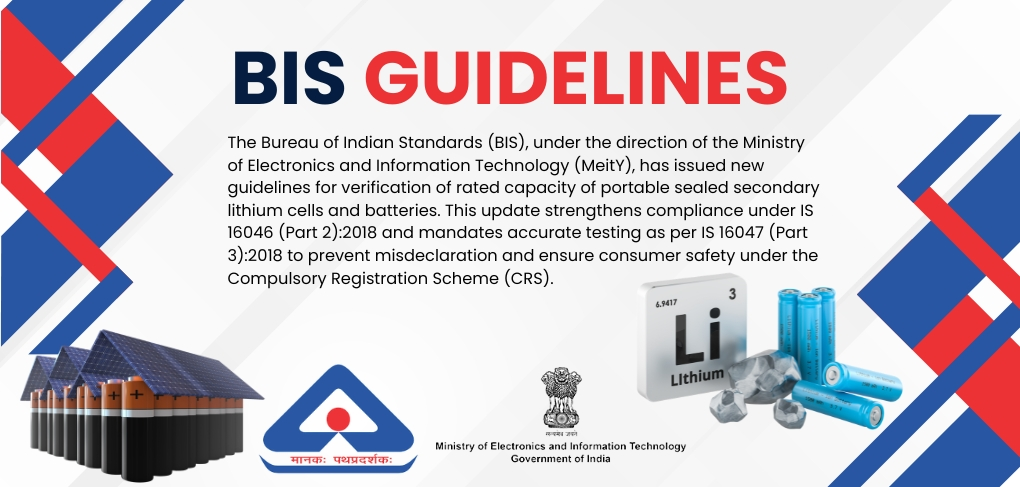
The Bureau of Indian Standards (BIS), under directions from the Ministry of Electronics and Information Technology (MeitY), has released important implementation guidelines regarding the verification of rated capacity for portable sealed secondary lithium cells and batteries.
This update is issued in reference to compliance under IS 16046 (Part 2):2018 / IEC 62133- 2:2017, which is already mandated under the Electronics and IT Goods (Requirement of Compulsory Registration) Order, 2021.
Why This Notification Was Issued
As per MeitY’s Order dated 03 February 2026, several instances of misdeclaration of rated capacity were observed in lithium cells and batteries.
To protect consumer interests, it has now been mandated that:
The rated capacity must be measured and verified in accordance with Clause 7.3.1 of IS 16047 (Part 3):2018 / IEC 61960-3:2017 and reported for compliance under IS 16046 (Part 2).
- Declared battery capacity matches actual performance
- Consumers receive products meeting stated specifications
- Misleading capacity claims are eliminated
What Is the New Requirement?
All portable sealed secondary lithium cells and batteries registered under IS 16046 (Part 2) must now undergo:
Verification of Rated Capacity
As per Clause 7.3.1 of IS 16047 (Part 3):2018 / IEC 61960-3:2017 (Test: Discharge Performance at 20°C – Rated Capacity)
- Measured capacity must be reported in the modified Unified Test Report Format
- Test reports must clearly reference earlier safety testing under IS 16046 (Part 2)
Implementation Guidelines
A. For Existing Licensees
License Valid Till 30 April 2027
Must ensure compliance with Clause 7.3.1 by 30 April 2027
License Valid Beyond 30 April 2027
Must comply by the last date of licence validity
Mandatory Actions
- Submit third-party lab test reports for all lead models
- Generate test request through LIMS
- Apply online via Standard Revision/Amendment/Essential Requirement module
- Submit undertaking confirming compliance of remaining models
Non-Compliance Consequences
Failure to comply may lead to:
- Suspension of licence
- Cancellation of licence
- Deletion of models from scope
B. For New Applicants
- Applications already tested may be processed without additional testing
- Applications under process must submit an undertaking to provide rated capacity test report before licence validity ends
- After 30 April 2027, no licence will be granted without rated capacity test reporting
Impact on Manufacturers & Importers
This notification significantly strengthens compliance requirements under BIS CRS for lithium batteries. Manufacturers must now:
- Ensure technical accuracy of declared rated capacity
- Conduct discharge performance testing at 20°C
- Coordinate with BIS-recognized third-party laboratories
- Update documentation and test reports
This change will improve transparency and product reliability in India’s electronics market.
How This Affects the Industry
- Greater scrutiny on lithium battery performance claims
- Increased testing and documentation requirements
- Enhanced consumer trust
- Reduced market entry of substandard products
Conclusion
The latest guidelines issued by BIS, following MeitY’s directive, mark a crucial step toward ensuring accurate capacity declaration and safeguarding consumer interests. Manufacturers and importers dealing with lithium cells and batteries under IS 16046 (Part 2):2018 must take immediate action to align with the new rated capacity verification requirements. Early compliance will help avoid last-minute rush, suspension risks, and delays in renewal or scope extension.
- BIS CRS registration
- Rated capacity testing coordination
- Standard revision filings
- Documentation and LIMS submission
- Change in scope applications
Our regulatory experts can support you through the entire compliance process.
Contact us today to ensure seamless compliance with the updated BIS guidelines.